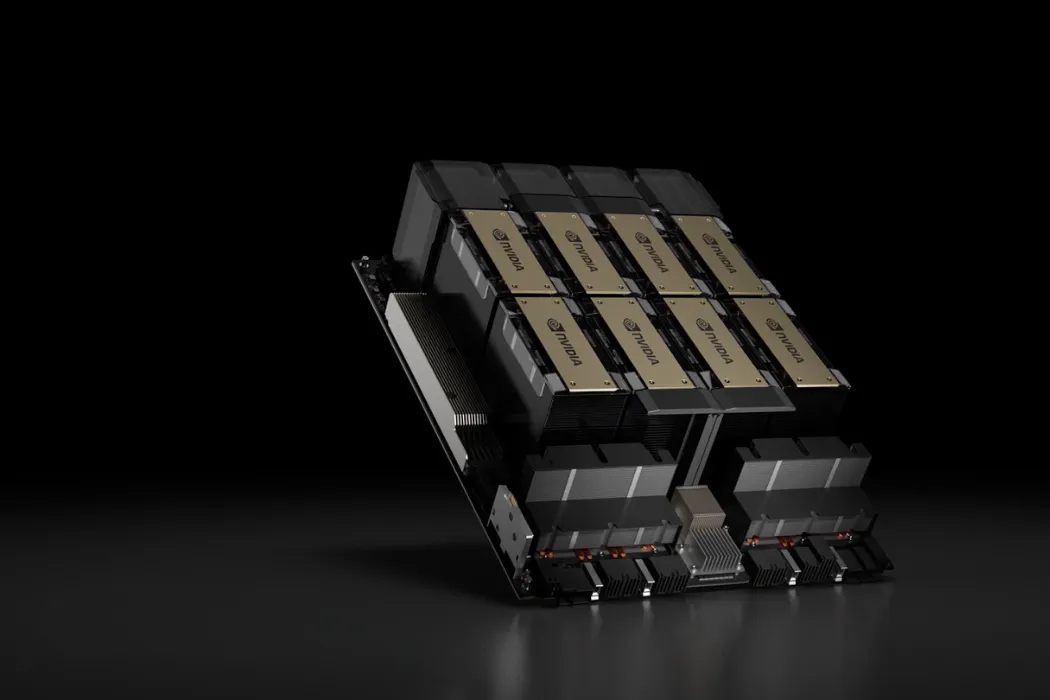
Take a moment and look around you. The Wi-Fi router blinking in the corner, the powerful computer on your desk, the smart TV in your living room, and even the car you drive—they all rely on a silent, unsung hero: the aluminum heat sink. This simple piece of metal is one of the most critical components in modern electronics, quietly preventing the digital heart of our world from melting down. It’s the ultimate example of “set it and forget it” engineering. But here’s something most people don’t realize: not all heat sinks are created equal. Choosing the wrong one is like putting bicycle tires on a race car. It can lead to frustrating performance throttling, a drastically shortened product lifespan, or even catastrophic, costly failure. The difference between a reliable product and a failed one often comes down to this single, overlooked component.
An aluminum heat sink is a thermal management device that dissipates heat from an electronic component into the surrounding air. It is popular because aluminum offers an exceptional balance of thermal conductivity, light weight, and low cost. By maximizing its surface area with fins, a heat sink uses natural convection and conduction to keep critical components running cool, ensuring both performance and long-term reliability for countless electronic applications.
So how do you navigate this world of fins, alloys, and manufacturing processes? How do you know if a simple extruded block is enough, or if you need a high-performance, custom-engineered solution? This expert guide will pull back the curtain on the world of aluminum heat sinks. We’ll explore why aluminum is the king of cooling, how different types are made, which one is right for you, and how partnering with a thermal expert can unlock the full potential of your product. Let’s dive in.
 What Is an Aluminum Heat Sink and Why Is It So Popular?
An aluminum heat sink is a passive cooling device that transfers heat generated by an electronic component to a fluid medium, usually air. It’s so popular because aluminum hits the sweet spot for thermal management: it conducts heat very well, it’s lightweight, it’s easy to manufacture into complex shapes, and it’s incredibly cost-effective. This unique combination of properties makes it the go-to material for over 90% of cooling applications.
The Simple Science of Heat Dissipation
A heat sink’s job seems simple, but it relies on two fundamental principles of physics working in perfect harmony:
- Conduction: First, heat moves from the hot component (like a CPU) directly into the flat base of the heat sink. This happens because the two surfaces are in direct contact. Think of it like a hot pan handle heating up your hand—the heat is conducted directly.
- Convection: Next, the heat spreads from the base up into the fins. These fins are designed to have a massive surface area. The air touching the hot fins warms up, becomes less dense, and naturally rises. This pulls in cooler, denser air to take its place, creating a slow, continuous, and silent airflow that carries the heat away.
The more surface area the fins have, the faster this convection process happens, and the cooler the component stays.
Why Aluminum? The Perfect Balance of Cost, Weight, and Performance
While materials like copper and even diamond are better thermal conductors, aluminum remains the undisputed champion for most applications. Here’s why:
- Great Conductivity-to-Weight Ratio: Aluminum is an excellent heat conductor. While not as good as copper, it’s far lighter, making it ideal for applications where weight is a concern.
- Cost-Effectiveness: Aluminum is abundant and relatively inexpensive. This allows for the creation of effective cooling solutions without significantly increasing the final product’s cost.
- Ease of Manufacturing: Aluminum is a soft, malleable metal. It can be easily extruded, machined, or forged into the complex fin geometries needed for optimal performance. Specific alloys like 6061 and 6063 are commonly used because they offer the best mix of thermal properties and workability.
Key Terminology You Should Know
To talk about heat sinks like an expert, you need to know the language:
- Thermal Resistance (Rth): This is the most important metric. Measured in °C/W, it tells you how many degrees Celsius a heat sink’s temperature will rise for every watt of heat it absorbs. A lower number is always better.
- Fin Efficiency: This measures how effectively the fins transfer heat to the air compared to an ideal, perfectly conductive fin. Taller, thinner fins can sometimes be less efficient at their tips.
- Thermal Design Power (TDP): This is the maximum amount of heat (in watts) that a component is expected to generate, which the cooling system needs to dissipate.
How Are Aluminum Heat Sinks Made?
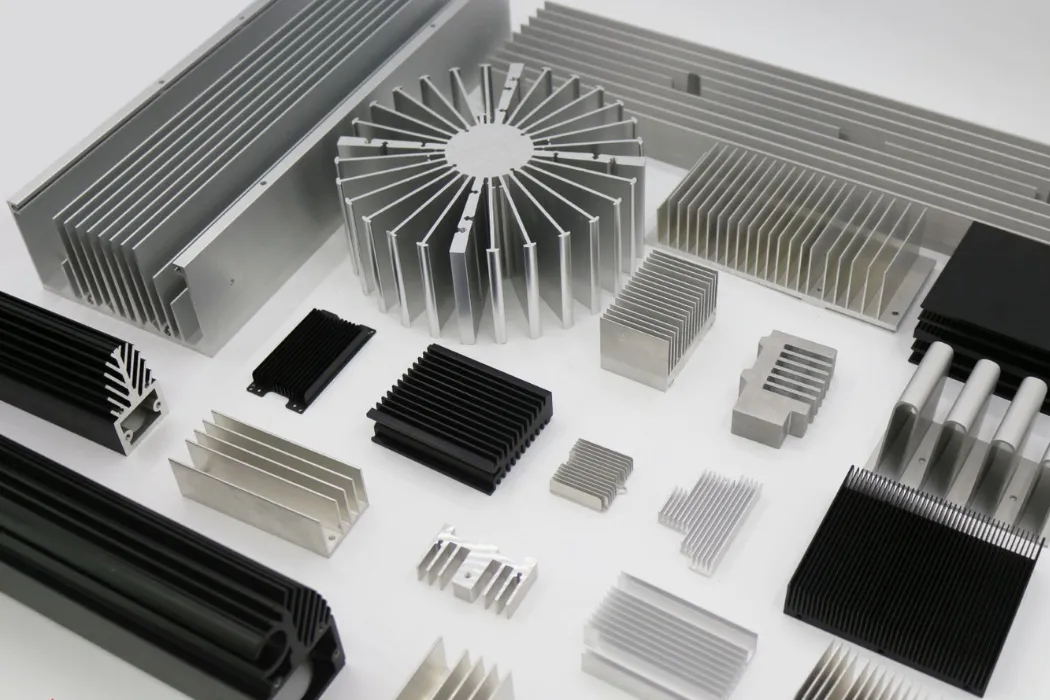
Aluminum heat sinks are made using several manufacturing processes, each with unique strengths suited for different applications and performance needs. The most common method is extrusion, a cost-effective process for high-volume production. For more complex and high-performance designs, advanced techniques like CNC machining, skiving, and forging are used to create intricate shapes and maximize cooling surface area, ensuring the right solution exists for any thermal challenge.
Extrusion: The Workhorse of the Industry
This is the most popular and cost-effective method. It works like a cookie press. A heated log of aluminum alloy, called a billet, is forced through a shaped die. The result is a long piece of aluminum with the exact cross-sectional profile of the heat sink’s fins. It’s then cut to the desired length.
Extrusion is perfect for creating large quantities of heat sinks with consistent designs. It’s highly efficient, which keeps costs down. However, it has limitations on how thin and tall the fins can be, which can cap its maximum thermal performance.
CNC Machining: For Ultimate Precision and Complex Geometries
For the most demanding applications, a solid block of aluminum is precision-carved using a Computer Numerical Control (CNC) machine. This process offers almost unlimited design freedom. It can create complex pin-fin patterns, unique mounting holes, and ultra-flat bases for perfect contact with the component.
At Walmate Thermal, our advanced CNC machining capabilities allow us to produce highly customized heat sinks tailored to our clients’ exact specifications. This is essential for high-tech industries like aerospace, medical devices, and high-performance computing, where an off-the-shelf solution simply won’t do.
Skiving and Bonded Fins: For High-Density Applications
When you need the absolute maximum surface area in a very small space, skiving is the answer. This incredible technique uses a special cutting tool to shave ultra-thin, densely packed fins from a solid block of aluminum or copper. The fins remain part of the base, ensuring perfect thermal integrity.
As a core technology at Walmate Thermal, **skived fin heat sinks** allow us to deliver superior cooling performance for compact, high-power electronics. A similar high-performance method is “bonded fin,” where individual fins are attached to a base using a strong, thermally conductive epoxy or brazing, allowing for very tall fins and hybrid metal combinations.
Stamping and Forging: For High-Volume and Unique Shapes
Stamping is used to create thin, lightweight fins from sheets of aluminum, which are often used in high-volume consumer electronics. Forging is a process where aluminum is hammered or pressed into shape under immense pressure, resulting in a strong, void-free structure that’s great for certain high-vibration environments.
What Are the Different Types of Aluminum Heat Sinks?
There are several types of aluminum heat sinks, each designed for specific thermal challenges. The most common is the extruded heat sink, the industry standard for general use. For more demanding applications, skived fin heat sinks offer maximum surface area in compact spaces. For the highest heat loads, heat pipe assemblies combine aluminum with copper heat pipes to supercharge performance, offering a solution for nearly any power level.
Dive Deeper: Exploring the Heat Sink Family
Understanding the different types is key to selecting the right one. Let’s break down the main categories:
- Extruded Heat Sinks: These are the familiar, classic heat sinks you see everywhere. They offer good performance for low-to-medium power applications and are incredibly cost-effective to produce in large volumes. Their design, however, is limited to a single 2D pattern.
- Skived Fin Heat Sinks: As discussed, these are performance champions. The ability to create very thin, tall, and densely packed fins means they can dissipate far more heat from a smaller footprint compared to an extruded part. They are ideal for powerful, space-constrained devices.
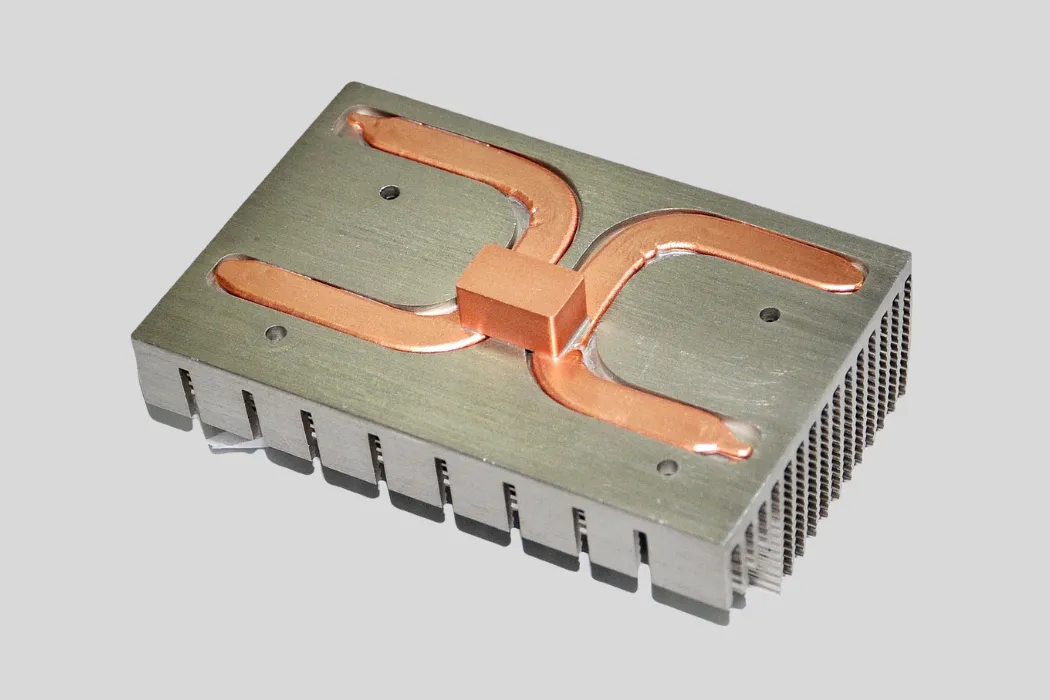
- Heat Pipe Assemblies: This is a hybrid technology for serious cooling. These clever devices embed sealed copper tubes containing a small amount of liquid into an aluminum base. The liquid vaporizes at the hot end, instantly moves the heat to the cooler fins, and condenses. This “phase-change cooling” is extremely efficient at moving heat away from a concentrated source. Walmate specializes in these complex assemblies for high-TDP processors.
- Stamped & Folded Fin Heat Sinks: These are made from sheets of aluminum that are stamped and then bonded or folded together. They are very lightweight and inexpensive to make in extremely high volumes, making them common in consumer electronics and LED lighting.
To make the choice clearer, here is a direct comparison of the most common types:
| Heat Sink Type | Key Advantage | Best Use Case | Relative Cost | Design Flexibility |
|---|---|---|---|---|
| Extruded | Low Cost, High Volume | General electronics, power supplies, routers | $ | Low (2D Profile) |
| Skived Fin | High Fin Density, Excellent Performance | Compact servers, high-power LEDs, embedded systems | $$$ | Moderate |
| Heat Pipe Assembly | Superior Heat Spreading, High TDP | High-end CPUs/GPUs, industrial computers | $$$$ | High (Custom) |
| Stamped Fin | Very Low Cost, Lightweight | Consumer electronics, automotive components | $ | Moderate |
Which is Better: Aluminum or Copper Heat Sinks?
Choosing between aluminum and copper depends on your priorities. For most applications, aluminum is better due to its excellent combination of low cost, light weight, and good thermal performance. However, for high-power applications where maximum heat transfer is critical and cost is less of a concern, copper’s superior thermal conductivity makes it the clear performance winner. Often, the best solution is a hybrid of both.
The Strong Case for Aluminum
For the vast majority of electronic devices, aluminum is the right choice. Let’s look at its winning combination of traits:
- Cost: Aluminum is significantly cheaper than copper. This is often the deciding factor, especially for products manufactured at scale.
- Weight: Aluminum has about one-third the density of copper. A copper heat sink of the same size is much heavier, which can be a major problem in portable devices or systems where board stress is a concern.
- Machinability: Aluminum is easier and faster to machine and extrude, which further reduces manufacturing costs and lead times.
Because of these factors, if an aluminum heat sink can meet your thermal requirements, it is almost always the more practical and economical solution.
The Performance Case for Copper
There’s no denying the physics: copper is a thermal superstar. It has roughly double the thermal conductivity of aluminum. This means it can absorb heat from a component and spread it across its base much, much faster. This is crucial when dealing with very high Thermal Design Power (TDP) processors, where heat is generated in a small, concentrated area. If you can’t pull that heat away quickly enough, the chip will overheat, no matter how good your fins are.
Think of it this way: if your heat source is a tiny, white-hot spot, you need a material that can act like a sponge and soak up that intense heat instantly. That’s copper’s job. Aluminum is better at the second part of the job: dissipating that heat over a large area to the air.
The Best of Both Worlds: Hybrid Copper/Aluminum Solutions
This is where expert thermal engineering comes into play. Since each metal excels at a different part of the cooling process, why not combine them? High-performance thermal solutions often use a hybrid design:
- A solid **copper base** sits directly on the hot component to rapidly pull the heat away.
- Lightweight **aluminum fins** are then bonded or brazed to the copper base to provide a large, cost-effective surface area for dissipating the heat to the air.
This custom approach gives you the high-performance heat absorption of copper without the full weight and cost penalty. It’s a perfect example of why a custom-designed solution from an expert like Walmate Thermal is often superior to a generic, single-material part.
How Do You Choose the Right Aluminum Heat Sink?
Choosing the right aluminum heat sink is a systematic process. It starts with calculating your “thermal budget”—the amount of heat you need to dissipate and the maximum temperature your component can tolerate. Next, you must consider the physical constraints of your design, like available space and airflow. Finally, using thermal simulation software to model performance before production is the best way to guarantee you’ve made the right choice, avoiding costly trial and error.
Step 1: Defining Your Thermal Budget (Heat Load & Max Temperature)
Before you look at a single heat sink, you need to know two numbers:
- The Heat Load (TDP): How many watts does your component generate at maximum load? You can find this in the component’s datasheet.
- The Maximum Junction Temperature (Tj-max): What is the highest internal temperature the component can safely reach? This is also in the datasheet.
You also need to know your maximum ambient operating temperature. With these numbers, you can calculate the required thermal resistance of your heat sink. If the calculated requirement is lower than what a specific heat sink can provide, you know it’s not the right choice.
Step 2: Considering Space, Airflow, and a Fan
A heat sink’s performance is not absolute; it depends entirely on its environment.
- Space Constraints: How much physical volume (length x width x height) do you have available for the cooling solution? This will immediately limit your options.
- Airflow: Is the heat sink in an open environment or a sealed box? Will there be natural airflow, or will the air be stagnant? The amount of airflow is one of the biggest factors in a heat sink’s real-world performance.
- Passive vs. Active: Will the heat sink be passive (relying on natural convection) or active (with a fan blowing on it)? Adding even a small, slow-moving fan can double or triple a heat sink’s effectiveness.
Step 3: The Power of Thermal Simulation (CFD/FEA)
In the past, engineers often had to rely on guesswork and expensive physical prototypes. Today, we use powerful software to get it right the first time. **Computational Fluid Dynamics (CFD)** and **Finite Element Analysis (FEA)** software allow us to create a digital twin of your device. We can simulate how heat will flow from the component, through the heat sink, and into the air.
This is a core service we provide at Walmate Thermal. Our thermal engineering team can model different heat sink designs in your virtual environment to identify the most effective and cost-efficient solution *before* any metal is cut. This saves our clients invaluable time and development costs.
Step 4: Deciding Between an Off-the-Shelf Part vs. a Custom Design
For simple, low-power projects, a standard, off-the-shelf heat sink might work fine. But if your product has tight space constraints, a high heat load, or unique airflow characteristics, a custom-designed solution is almost always the better choice. A custom heat sink is designed to be a perfect fit for your product, ensuring optimal thermal performance, mechanical stability, and long-term reliability. While it may have an initial tooling cost, it often leads to a lower total cost of ownership by preventing field failures and improving product performance.
What Surface Finishes Are Used on Aluminum Heat Sinks and Why?
Surface finishes are applied to aluminum heat sinks for two main reasons: protection and performance. The most common finish is anodizing, which creates a hard, corrosion-resistant surface and can slightly improve thermal radiation. Other finishes like powder coating provide electrical insulation or aesthetic coloring, while chromate conversion coatings are used to protect the aluminum while maintaining its electrical conductivity. The right finish ensures the heat sink’s longevity and reliability.
Anodizing: The Most Common Finish for Corrosion Resistance and Emissivity
Anodizing is an electrochemical process that grows a durable, corrosion-resistant layer of aluminum oxide on the surface. This protects the heat sink from moisture and other environmental factors that could degrade it over time.
It also has a thermal benefit. For passive heat sinks that rely on natural convection, a significant portion of heat is dissipated through radiation. Raw aluminum is actually quite shiny and a poor radiator. **Black anodizing** dramatically increases the surface’s emissivity, allowing it to radiate heat more effectively. This can improve the performance of a passive heat sink by 5-15%.
Powder Coating and Painting: For Aesthetics and Electrical Insulation
While not ideal for thermal performance (paint can act as an insulator), powder coating is sometimes used when a specific color is required for branding or when the heat sink needs to be electrically isolated from other components. It creates a thick, durable finish. However, the thermal performance penalty must be accounted for during the design phase.
Chromate Conversion Coating: For Priming and Maximum Conductivity
This is a chemical treatment that creates a thin protective layer on the aluminum. Unlike anodizing, a chromate conversion coat (like Alodine or Iridite) maintains the electrical conductivity of the surface. This is critical in applications where the heat sink is also part of the device’s electrical grounding path. It also provides an excellent base for painting if needed.
Why the Right Finish Matters for Performance and Reliability
Choosing a surface finish is not just a cosmetic decision. An inappropriate finish can hamper thermal performance or fail to protect the heat sink in a harsh environment. For example, using a standard anodize in a salty marine environment could lead to premature corrosion. Part of the expert design process is selecting a finish that balances thermal needs, environmental protection, and cost to ensure the product is reliable for its entire intended lifespan.
Frequently Asked Questions (FAQs)
-
1. Does the color of an aluminum heat sink really matter for performance?
- Yes, it can. For passive heat sinks (no fan), a black anodized finish radiates heat more effectively than a clear or raw aluminum finish, which can improve performance. For active heat sinks with a fan, the effect is negligible as forced convection is the dominant mode of heat transfer.
-
2. What is Thermal Interface Material (TIM) and do I always need it?
- TIM is a paste, pad, or grease applied between the component and the heat sink base. It fills in microscopic air gaps to ensure efficient heat transfer. Yes, you almost always need it. Without TIM, performance can be reduced by 30-50%.
-
3. Can I cut or drill into an aluminum heat sink myself?
- While you can, it’s generally not recommended. Drilling or cutting can create burrs that prevent the heat sink from sitting flat, ruining its performance. For custom modifications, it’s best to work with a manufacturer like Walmate to have it done with precision machinery.
-
4. How important is airflow for a passive aluminum heat sink?
- It is absolutely critical. A passive heat sink in a sealed box with no airflow will quickly become saturated and stop working effectively. The design of the product’s enclosure must allow for a clear path for cool air to enter and hot air to exit.
-
5. Is a heavier or bigger aluminum heat sink always better?
- Not necessarily. A larger heat sink has more surface area, which is good, but a poorly designed large heat sink can be outperformed by a smaller, intelligently designed one (e.g., a skived fin or heat pipe assembly). Design efficiency often matters more than raw size.
-
6. What’s the difference between a heat sink and a liquid cold plate?
- A heat sink transfers heat to the air. A liquid cold plate, another core Walmate product, transfers heat to a liquid that is pumped through it. Liquid cooling is a much more powerful technology used for very high heat loads where air cooling is no longer effective.
-
7. Why would I need a custom-designed heat sink instead of a standard one?
- You need a custom design when your product has unique space constraints, high performance requirements, or specific environmental challenges. A custom solution ensures a perfect fit and optimal performance, which a generic part can’t guarantee.
-
8. What does “No MOQ” mean for a custom heat sink order?
- “No Minimum Order Quantity” is a key advantage offered by Walmate Thermal. It means we can produce your custom design whether you need a few units for prototyping or tens of thousands for mass production, offering you maximum flexibility.
Conclusion: Your Partner for Perfect Thermal Management
As we’ve seen, the humble aluminum heat sink is a critical, highly engineered component. It’s far more than just a piece of metal. The optimal cooling solution for any product depends on a careful balance of the right material, the most effective manufacturing process, and an intelligent, validated design. While a generic, off-the-shelf heat sink can seem like an easy fix, it is often a compromise that can put your product’s performance and reliability at risk.
To guarantee your device runs cool under pressure, remains reliable for years, and is cost-effective at scale, a custom-engineered solution is the superior choice. This is where a true thermal partner makes all the difference.
Don’t let thermal challenges become your product’s downfall.
At Walmate Thermal, we are your one-stop partner for thermal solutions. We combine advanced thermal simulation, a wide range of manufacturing capabilities—from extrusion to high-performance skiving—and rigorous ISO9001/IATF16949 certified quality control to deliver the perfect custom aluminum heat sink for your needs.Contact our engineers today for a 24-hour quote and let’s build a cooler, more reliable product together.